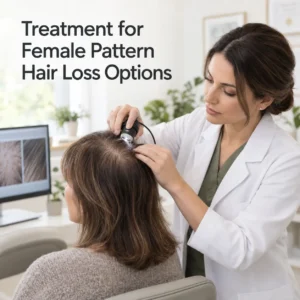

A widening parting, more scalp visible under bathroom lighting, or a receding hairline can make every new product promise feel urgent. So, does laser treatment help with hair loss? For the right person, low-level laser therapy can support thicker-looking, healthier hair and slow progressive thinning. It is not a miracle cure, and it is rarely the only treatment needed, but it can be a useful part of a medically guided hair-regrowth plan.
The key is identifying why your hair is thinning before investing time and money. Hair loss is not one condition, and the treatment that works well for hereditary thinning may do very little for shedding caused by stress, illness, nutritional deficiency or an inflammatory scalp condition.
Does laser treatment help with hair loss caused by hereditary thinning?
Laser hair-regrowth treatment is most commonly used for androgenetic alopecia, also known as male-pattern or female-pattern hair loss. This is the gradual, genetically influenced miniaturisation of hair follicles, often driven by sensitivity to DHT in men and hormonal and genetic factors in women.
Low-level laser therapy, sometimes called red-light therapy or photobiomodulation, uses specific wavelengths of red light delivered through a laser cap, helmet or in-clinic device. The treatment is designed to stimulate activity within the follicle cells, support circulation around the follicles and encourage hairs to remain in their growth phase for longer.
In practical terms, suitable patients may notice less shedding first. Over time, existing hairs may become stronger and thicker, and areas with weakened but still active follicles may appear denser. Results vary considerably. Laser therapy cannot reliably bring back hair from areas where follicles have been inactive for many years, particularly smooth, shiny areas of scalp with established baldness.
This distinction matters. If you are in the early or moderate stages of pattern hair loss, laser treatment may help preserve and improve the hair you still have. If loss is advanced, it may be better used to support existing hair alongside a wider programme, or before and after an FUE hair transplant where appropriate.
What the evidence means in real life
Clinical research on low-level laser therapy has found that it can improve hair count and hair density for some people with androgenetic hair loss. That does not mean every device, treatment schedule or patient produces the same result. Studies use different laser wavelengths, treatment durations and ways of measuring improvement.
The most realistic expectation is gradual improvement rather than an overnight transformation. Hair grows slowly, usually around one centimetre a month, and the growth cycle lasts months. Many patients need three to six months of consistent use before they can judge whether laser therapy is helping. More meaningful changes in density can take six to 12 months.
Photographs taken in the same lighting, from the same angles and at regular intervals are far more useful than checking your reflection each morning. Hair length, styling, humidity and lighting can all make density look better or worse from one day to the next.
Laser therapy works best as part of a treatment plan
For many people, laser treatment is more effective when combined with treatments that address the cause of thinning. A personalised plan may include prescription therapies, topical regrowth treatments, DHT inhibitors where clinically suitable, scalp care and nutritional support when an underlying deficiency is identified.
DHT inhibition can be particularly relevant for men with progressive pattern loss because it targets one of the primary drivers of follicle miniaturisation. For women, the right approach depends on age, medical history, hormonal status and the pattern of loss. Prescription treatment is never a one-size-fits-all decision and should be assessed properly before it is started.
A medicated shampoo may also have a role where dandruff, irritation, excess oil or inflammation is affecting scalp health. It will not replace a proven hair-loss treatment on its own, but a healthier scalp provides a better environment for the hair you are trying to protect.
Laser treatment is therefore best viewed as a supportive clinical tool, not a replacement for diagnosis. Patients often lose valuable time by trying several expensive cosmetic products before addressing the actual cause of their hair loss.
Who may not be a good candidate for laser hair treatment?
Laser therapy is not the answer to every type of shedding. Sudden diffuse hair loss after illness, major stress, rapid weight loss, surgery or childbirth may be telogen effluvium. In these cases, the priority is finding and addressing the trigger. Hair often improves as the body recovers, although persistent shedding should be investigated.
Patchy hair loss can indicate alopecia areata, while pain, scaling, pustules or scarring may point to a scalp disorder requiring prompt medical assessment. These conditions need the correct diagnosis rather than a generic regrowth device.
Laser treatment also has limitations in advanced baldness. It may improve the calibre of remaining hairs around a thinning area, but it cannot create new follicles where there are none. FUE transplantation may be considered for suitable candidates who have stable loss and an adequate donor area, usually alongside a plan to protect the surrounding natural hair.
What does laser hair treatment involve?
Treatment protocols depend on the device and the individual plan. Some patients attend a clinic for scheduled sessions, while others use an approved home device several times per week. Consistency is essential. Using a laser cap occasionally, then stopping for weeks, is unlikely to provide a fair test of whether it works for you.
Sessions are generally comfortable and non-invasive. There is no recovery period, no need to take time off work and no change to your usual styling routine. This makes laser therapy appealing to people who want a non-surgical option or who are not ready for prescription medication or transplant surgery.
However, convenience should not be confused with effort-free treatment. Most successful programmes require ongoing use to maintain benefits. If treatment stops, any gains may gradually be lost as the underlying pattern hair-loss process continues.
Safety, side effects and realistic expectations
When an appropriate device is used as directed, low-level laser therapy is generally well tolerated. Some people experience temporary scalp sensitivity, mild irritation or headache, although these effects are uncommon. People with photosensitivity, those taking medicines that increase light sensitivity, and anyone with an unexplained scalp condition should seek professional advice before starting.
Be cautious about devices that promise dramatic regrowth in a matter of weeks or guarantee results for everyone. Hair follicles respond differently according to genetics, hormone sensitivity, age, duration of loss and overall scalp health. A credible provider will discuss those variables openly rather than selling a single treatment as the answer for every concern.
A proper assessment should consider your medical history, current medicines, family history of hair loss, recent health changes and clear scalp photographs. Blood tests may also be appropriate where symptoms suggest iron deficiency, thyroid changes or other underlying contributors. This creates a treatment plan based on evidence rather than guesswork.
When to seek personalised support
If your hairline is receding, your parting is becoming wider or your ponytail feels noticeably thinner, early action usually gives you more options. The follicles are easier to support before they have miniaturised beyond recovery.
At Hair Formulas, treatment recommendations are shaped by clinical consultation and the experience of pharmacists, trichologists and dermatologists. A remote assessment can help establish whether laser therapy, prescription treatment, DHT management, scalp care or a combined approach is most appropriate for your stage of hair loss.
Do not let uncertainty keep you cycling through cosmetic products that make bold claims but offer little measurable progress. Request a consultation, assess the cause of your thinning and choose a plan you can follow consistently. The best time to protect your hair is while there is still hair to protect.